> ## Documentation Index
> Fetch the complete documentation index at: https://docs.release0.com/llms.txt
> Use this file to discover all available pages before exploring further.
# Using custom HTML and JavaScript with your Agent
> Learn how to integrate Release0 agents using HTML and JavaScript for web applications. Customize agent appearance, trigger actions, and handle events with ease using the provided code snippets and examples.
## Standard
You can get the standard HTML and JavaScript code by clicking on the “HTML & Javascript” button in the “Share” tab of your **agent dialog**. In this section, you can modify container dimensions.
Below is an example:
```html theme={null}
```
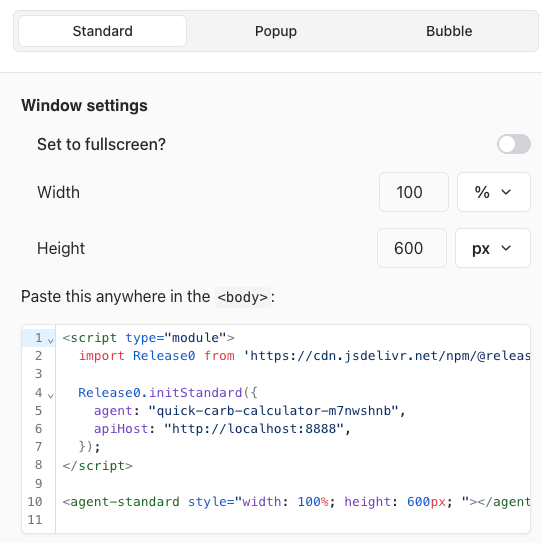 This code is creating a container with a 100% width (will match parent width) and 600px height.
```ts theme={null}
type AgentProps = {
id?: string;
agent: string | any;
isPreview?: boolean;
resultId?: string;
initialContext?: Record;
apiHost?: string;
font?:
| string
| {
type: "Google";
family?: string | undefined;
}
| {
type: "Custom";
url?: string | undefined;
family?: string | undefined;
css?: string | undefined;
};
progressBarRef?: HTMLDivElement;
startFrom?:
| {
type: "group";
groupId: string;
}
| {
type: "event";
eventId: string;
};
sessionId?: string;
theme?: {
chatWindow?: {
backgroundColor?: string;
maxWidth?: string;
maxHeight?: string;
};
button?: {
size?: "medium" | "large" | `${number}px`;
backgroundColor?: string;
iconColor?: string;
customIconSrc?: string;
customCloseIconSrc?: string;
};
previewMessage?: {
backgroundColor?: string;
textColor?: string;
closeButtonBackgroundColor?: string;
closeButtonIconColor?: string;
};
placement?: "left" | "right";
};
previewMessage?: {
avatarUrl?: string;
message: string;
autoShowDelay?: number;
};
autoShowDelay?: number;
onNewInputelement?: (inputelement: any) => void;
onAnswer?: (answer: { message: string; elementId: string }) => void;
onInit?: () => void;
onEnd?: () => void;
onNewLogs?: (
logs: {
status: string;
description: string;
details?: unknown;
}[],
) => void;
onChatStatePersisted?: (isEnabled: boolean) => void;
onScriptExecutionSuccess?: (message: string) => void;
};
```
### Multiple agents
To display multiple agents on the same page, assign unique `id`props to each:
```html theme={null}
...
```
## Popup
Get the popup HTML and JavaScript code by clicking on the “HTML & Javascript” button in the “Share” tab of your agent dialog.
This code is creating a container with a 100% width (will match parent width) and 600px height.
```ts theme={null}
type AgentProps = {
id?: string;
agent: string | any;
isPreview?: boolean;
resultId?: string;
initialContext?: Record;
apiHost?: string;
font?:
| string
| {
type: "Google";
family?: string | undefined;
}
| {
type: "Custom";
url?: string | undefined;
family?: string | undefined;
css?: string | undefined;
};
progressBarRef?: HTMLDivElement;
startFrom?:
| {
type: "group";
groupId: string;
}
| {
type: "event";
eventId: string;
};
sessionId?: string;
theme?: {
chatWindow?: {
backgroundColor?: string;
maxWidth?: string;
maxHeight?: string;
};
button?: {
size?: "medium" | "large" | `${number}px`;
backgroundColor?: string;
iconColor?: string;
customIconSrc?: string;
customCloseIconSrc?: string;
};
previewMessage?: {
backgroundColor?: string;
textColor?: string;
closeButtonBackgroundColor?: string;
closeButtonIconColor?: string;
};
placement?: "left" | "right";
};
previewMessage?: {
avatarUrl?: string;
message: string;
autoShowDelay?: number;
};
autoShowDelay?: number;
onNewInputelement?: (inputelement: any) => void;
onAnswer?: (answer: { message: string; elementId: string }) => void;
onInit?: () => void;
onEnd?: () => void;
onNewLogs?: (
logs: {
status: string;
description: string;
details?: unknown;
}[],
) => void;
onChatStatePersisted?: (isEnabled: boolean) => void;
onScriptExecutionSuccess?: (message: string) => void;
};
```
### Multiple agents
To display multiple agents on the same page, assign unique `id`props to each:
```html theme={null}
...
```
## Popup
Get the popup HTML and JavaScript code by clicking on the “HTML & Javascript” button in the “Share” tab of your agent dialog.
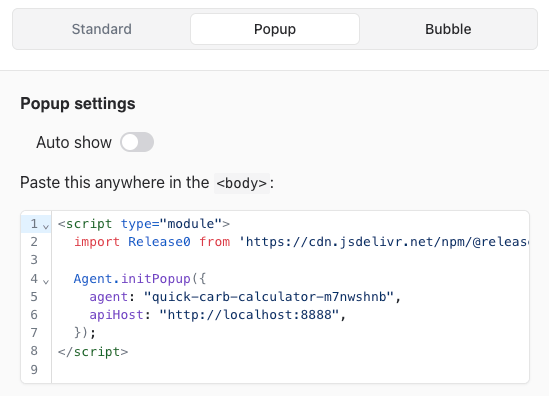 This will trigger the popup window automatically after **3 seconds**.
```ts theme={null}
type PopupProps = {
id?: string;
agent: string | any;
isPreview?: boolean;
resultId?: string;
initialContext?: Record;
apiHost?: string;
font?:
| string
| {
type: "Google";
family?: string | undefined;
}
| {
type: "Custom";
url?: string | undefined;
family?: string | undefined;
css?: string | undefined;
};
progressBarRef?: HTMLDivElement;
startFrom?:
| {
type: "group";
groupId: string;
}
| {
type: "event";
eventId: string;
};
sessionId?: string;
theme?: {
chatWindow?: {
backgroundColor?: string;
maxWidth?: string;
maxHeight?: string;
};
button?: {
size?: "medium" | "large" | `${number}px`;
backgroundColor?: string;
iconColor?: string;
customIconSrc?: string;
customCloseIconSrc?: string;
};
previewMessage?: {
backgroundColor?: string;
textColor?: string;
closeButtonBackgroundColor?: string;
closeButtonIconColor?: string;
};
placement?: "left" | "right";
};
previewMessage?: {
avatarUrl?: string;
message: string;
autoShowDelay?: number;
};
autoShowDelay?: number;
onNewInputelement?: (inputelement: any) => void;
onAnswer?: (answer: { message: string; elementId: string }) => void;
onInit?: () => void;
onEnd?: () => void;
onNewLogs?: (
logs: {
status: string;
description: string;
details?: unknown;
}[],
) => void;
onChatStatePersisted?: (isEnabled: boolean) => void;
onScriptExecutionSuccess?: (message: string) => void;
autoShowDelay?: number;
theme?: {
width?: string;
backgroundColor?: string;
zIndex?: number;
};
defaultOpen?: boolean;
isOpen?: boolean;
onOpen?: () => void;
onClose?: () => void;
};
```
## Bubble
Click the “HTML & Javascript” button in the “Share” tab of your **agent dialog** to integrate the bubble.
This will trigger the popup window automatically after **3 seconds**.
```ts theme={null}
type PopupProps = {
id?: string;
agent: string | any;
isPreview?: boolean;
resultId?: string;
initialContext?: Record;
apiHost?: string;
font?:
| string
| {
type: "Google";
family?: string | undefined;
}
| {
type: "Custom";
url?: string | undefined;
family?: string | undefined;
css?: string | undefined;
};
progressBarRef?: HTMLDivElement;
startFrom?:
| {
type: "group";
groupId: string;
}
| {
type: "event";
eventId: string;
};
sessionId?: string;
theme?: {
chatWindow?: {
backgroundColor?: string;
maxWidth?: string;
maxHeight?: string;
};
button?: {
size?: "medium" | "large" | `${number}px`;
backgroundColor?: string;
iconColor?: string;
customIconSrc?: string;
customCloseIconSrc?: string;
};
previewMessage?: {
backgroundColor?: string;
textColor?: string;
closeButtonBackgroundColor?: string;
closeButtonIconColor?: string;
};
placement?: "left" | "right";
};
previewMessage?: {
avatarUrl?: string;
message: string;
autoShowDelay?: number;
};
autoShowDelay?: number;
onNewInputelement?: (inputelement: any) => void;
onAnswer?: (answer: { message: string; elementId: string }) => void;
onInit?: () => void;
onEnd?: () => void;
onNewLogs?: (
logs: {
status: string;
description: string;
details?: unknown;
}[],
) => void;
onChatStatePersisted?: (isEnabled: boolean) => void;
onScriptExecutionSuccess?: (message: string) => void;
autoShowDelay?: number;
theme?: {
width?: string;
backgroundColor?: string;
zIndex?: number;
};
defaultOpen?: boolean;
isOpen?: boolean;
onOpen?: () => void;
onClose?: () => void;
};
```
## Bubble
Click the “HTML & Javascript” button in the “Share” tab of your **agent dialog** to integrate the bubble.
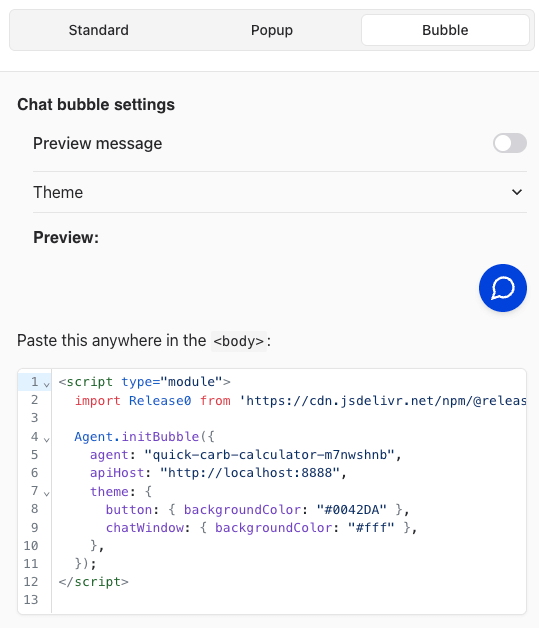 Here is an example:
```html theme={null}
```
This will display a bubble with a preview message after **5 seconds**.
```ts theme={null}
type BubbleProps = {
id?: string;
agent: string | any;
isPreview?: boolean;
resultId?: string;
initialContext?: Record;
apiHost?: string;
font?:
| string
| {
type: "Google";
family?: string | undefined;
}
| {
type: "Custom";
url?: string | undefined;
family?: string | undefined;
css?: string | undefined;
};
progressBarRef?: HTMLDivElement;
startFrom?:
| {
type: "group";
groupId: string;
}
| {
type: "event";
eventId: string;
};
sessionId?: string;
theme?: {
chatWindow?: {
backgroundColor?: string;
maxWidth?: string;
maxHeight?: string;
};
button?: {
size?: "medium" | "large" | `${number}px`;
backgroundColor?: string;
iconColor?: string;
customIconSrc?: string;
customCloseIconSrc?: string;
};
previewMessage?: {
backgroundColor?: string;
textColor?: string;
closeButtonBackgroundColor?: string;
closeButtonIconColor?: string;
};
placement?: "left" | "right";
};
previewMessage?: {
avatarUrl?: string;
message: string;
autoShowDelay?: number;
};
autoShowDelay?: number;
onNewInputelement?: (inputelement: any) => void;
onAnswer?: (answer: { message: string; elementId: string }) => void;
onInit?: () => void;
onEnd?: () => void;
onNewLogs?: (
logs: {
status: string;
description: string;
details?: unknown;
}[],
) => void;
onChatStatePersisted?: (isEnabled: boolean) => void;
onScriptExecutionSuccess?: (message: string) => void;
onOpen?: () => void;
onClose?: () => void;
onPreviewMessageClick?: () => void;
onPreviewMessageDismissed?: () => void;
};
```
### Custom button position
You can adjust the position of the button with custom CSS. For example:
```css theme={null}
agent-bubble::part(button) {
bottom: 60px;
}
agent-bubble::part(agent) {
bottom: 140px;
height: calc(100% - 140px)
}
```
If you have a preview message, you'll also have to manually position it:
```css theme={null}
agent-bubble::part(preview-message) {
bottom: 140px;
}
```
## Commands
Here are the commands you can use to trigger your embedded agent:
* `Agent.open()`: Open popup or bubble
* `Agent.close()`: Close popup or bubble
* `Agent.toggle()`: Toggle the bubble or popup open/close state,
* `Agent.showPreviewMessage()`: Show preview message from the bubble,
* `Agent.hidePreviewMessage()`: Hide preview message from the bubble,
* `Agent.setPrefilledVariables(...)`: Set prefilled variables.
Example:
```js theme={null}
Agent.setPrefilledVariables({
Name: 'Jhon',
Email: 'john@gmail.com',
})
```
For more information, check out [Additional configuration](#additional-configuration).
* `Agent.setInputValue(...)`: Set the value in the currently displayed input.
You can bind these commands on a button element, for example:
```html theme={null}
```
For each command you can pass an optional `id` prop to target a specific agent. I.e. `Agent.open({ id: 'my-bubble' })`
## Callbacks
If you need to trigger events on your parent website when the user interact with the agent, you can use the following callbacks:
```js theme={null}
Agent.initStandard({
agent: 'my-agent',
onNewInputelement: (
) => {
console.log('New input element displayed', inputelement.id)
},
onAnswer: (answer) => {
console.log('Answer received', answer.message, answer.elementId)
},
onInit: () => {
console.log('Agent initialized')
},
onEnd: () => {
console.log('Agent ended')
},
})
```
## Additional configuration
You can prefill the agent variable values in your embed code by adding the `initialContext` option. Here is an example:
```js theme={null}
Agent.initStandard({
agent: 'my-agent',
initialContext: {
'Current URL': 'https://release0.com',
'User name': 'John Doe',
},
})
```
It will prefill the `Current URL` variable with "[https://release0.com](https://release0.com)" and the `User name` variable with "John Doe". More info about variables: [here](../../../editor/variables).
Note that if your site URL contains query params (i.e. [https://r0.ar/myagent?User%20name=John%20Doe](https://r0.ar/myagent?User%20name=John%20Doe)), the variables will automatically be injected to the agent. So you don't need to manually transfer query params to the agent embed configuration.
Here is an example:
```html theme={null}
```
This will display a bubble with a preview message after **5 seconds**.
```ts theme={null}
type BubbleProps = {
id?: string;
agent: string | any;
isPreview?: boolean;
resultId?: string;
initialContext?: Record;
apiHost?: string;
font?:
| string
| {
type: "Google";
family?: string | undefined;
}
| {
type: "Custom";
url?: string | undefined;
family?: string | undefined;
css?: string | undefined;
};
progressBarRef?: HTMLDivElement;
startFrom?:
| {
type: "group";
groupId: string;
}
| {
type: "event";
eventId: string;
};
sessionId?: string;
theme?: {
chatWindow?: {
backgroundColor?: string;
maxWidth?: string;
maxHeight?: string;
};
button?: {
size?: "medium" | "large" | `${number}px`;
backgroundColor?: string;
iconColor?: string;
customIconSrc?: string;
customCloseIconSrc?: string;
};
previewMessage?: {
backgroundColor?: string;
textColor?: string;
closeButtonBackgroundColor?: string;
closeButtonIconColor?: string;
};
placement?: "left" | "right";
};
previewMessage?: {
avatarUrl?: string;
message: string;
autoShowDelay?: number;
};
autoShowDelay?: number;
onNewInputelement?: (inputelement: any) => void;
onAnswer?: (answer: { message: string; elementId: string }) => void;
onInit?: () => void;
onEnd?: () => void;
onNewLogs?: (
logs: {
status: string;
description: string;
details?: unknown;
}[],
) => void;
onChatStatePersisted?: (isEnabled: boolean) => void;
onScriptExecutionSuccess?: (message: string) => void;
onOpen?: () => void;
onClose?: () => void;
onPreviewMessageClick?: () => void;
onPreviewMessageDismissed?: () => void;
};
```
### Custom button position
You can adjust the position of the button with custom CSS. For example:
```css theme={null}
agent-bubble::part(button) {
bottom: 60px;
}
agent-bubble::part(agent) {
bottom: 140px;
height: calc(100% - 140px)
}
```
If you have a preview message, you'll also have to manually position it:
```css theme={null}
agent-bubble::part(preview-message) {
bottom: 140px;
}
```
## Commands
Here are the commands you can use to trigger your embedded agent:
* `Agent.open()`: Open popup or bubble
* `Agent.close()`: Close popup or bubble
* `Agent.toggle()`: Toggle the bubble or popup open/close state,
* `Agent.showPreviewMessage()`: Show preview message from the bubble,
* `Agent.hidePreviewMessage()`: Hide preview message from the bubble,
* `Agent.setPrefilledVariables(...)`: Set prefilled variables.
Example:
```js theme={null}
Agent.setPrefilledVariables({
Name: 'Jhon',
Email: 'john@gmail.com',
})
```
For more information, check out [Additional configuration](#additional-configuration).
* `Agent.setInputValue(...)`: Set the value in the currently displayed input.
You can bind these commands on a button element, for example:
```html theme={null}
```
For each command you can pass an optional `id` prop to target a specific agent. I.e. `Agent.open({ id: 'my-bubble' })`
## Callbacks
If you need to trigger events on your parent website when the user interact with the agent, you can use the following callbacks:
```js theme={null}
Agent.initStandard({
agent: 'my-agent',
onNewInputelement: (
) => {
console.log('New input element displayed', inputelement.id)
},
onAnswer: (answer) => {
console.log('Answer received', answer.message, answer.elementId)
},
onInit: () => {
console.log('Agent initialized')
},
onEnd: () => {
console.log('Agent ended')
},
})
```
## Additional configuration
You can prefill the agent variable values in your embed code by adding the `initialContext` option. Here is an example:
```js theme={null}
Agent.initStandard({
agent: 'my-agent',
initialContext: {
'Current URL': 'https://release0.com',
'User name': 'John Doe',
},
})
```
It will prefill the `Current URL` variable with "[https://release0.com](https://release0.com)" and the `User name` variable with "John Doe". More info about variables: [here](../../../editor/variables).
Note that if your site URL contains query params (i.e. [https://r0.ar/myagent?User%20name=John%20Doe](https://r0.ar/myagent?User%20name=John%20Doe)), the variables will automatically be injected to the agent. So you don't need to manually transfer query params to the agent embed configuration.